
Imagine an artificial intelligence system that can create photorealistic images of people who don’t exist, generate artwork in any style, or produce content that’s indistinguishable from reality. This isn’t science fiction—it’s the power of Generative Adversarial Networks, or GANs.
Since their introduction by Ian Goodfellow in 2014, GANs have revolutionized artificial intelligence and machine learning. What started as a theoretical framework has evolved into one of the most powerful tools for creating synthetic media, including everything from deepfakes to AI-generated art, and yes, NSFW (Not Safe For Work) content generators.
But what exactly are GANs, and how do they work? More importantly, why have they become the go-to technology for generating synthetic images, including controversial applications? This comprehensive guide will demystify the technology, explore its applications, and address the ethical considerations surrounding its use.
What is a GAN? Breaking Down the Basics
The Core Concept: Two Neural Networks in Competition
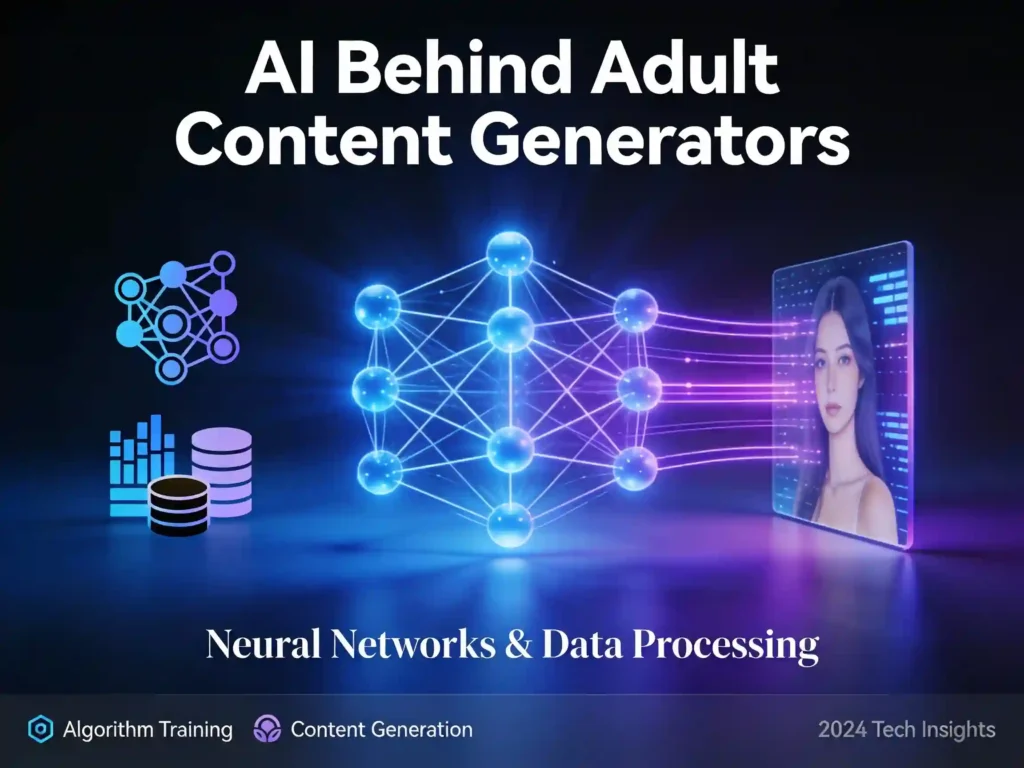
A Generative Adversarial Network is a machine learning framework consisting of two neural networks that compete against each other in a game-like scenario. Think of it as an art forger (the Generator) constantly trying to fool an art detective (the Discriminator).
The Generator creates fake images from random noise, attempting to produce outputs that look increasingly realistic.
The Discriminator examines images and determines whether they’re real (from the training dataset) or fake (created by the Generator).
This adversarial process continues with both networks improving simultaneously. The Generator gets better at creating realistic images, while the Discriminator becomes more skilled at detecting fakes. Eventually, the Generator produces images so convincing that even the Discriminator can’t reliably tell them apart from real ones.
The Mathematical Foundation
At its core, a GAN operates on a minimax game theory principle. The Generator (G) tries to minimize the probability that the Discriminator (D) correctly identifies fake images, while the Discriminator tries to maximize its accuracy in distinguishing real from fake.
The training process involves:
- Random Input: The Generator receives random noise (latent vector) as input
- Image Generation: It transforms this noise into a synthetic image
- Discrimination: The Discriminator evaluates both real training images and generated fakes
- Feedback Loop: Both networks adjust their parameters based on performance
- Iteration: This process repeats thousands or millions of times
How GANs Create Realistic Images
The Training Process Explained
Training a GAN is like teaching two students with opposing goals. Here’s how it works in practice:
Phase 1: Initial Training
The Generator starts by creating completely random, meaningless images
The Discriminator easily identifies these as fake
Both networks receive feedback and adjust their internal parameters
Phase 2: Progressive Improvement
The Generator begins recognizing patterns that fool the Discriminator
Images become slightly more structured and realistic
The Discriminator adapts to detect these new fake patterns
Phase 3: Advanced Generation
The Generator creates increasingly sophisticated images
The Discriminator’s job becomes more challenging
Both networks reach an equilibrium where generated images are nearly indistinguishable from real ones
Why GANs Excel at Image Generation
GANs have several advantages over other generative models:
Unsupervised Learning: GANs don’t require labeled data for every training example, making them efficient for large datasets
High-Quality Outputs: Unlike earlier methods, GANs can produce sharp, detailed images rather than blurry approximations
Versatility: The same basic architecture can generate faces, landscapes, objects, or abstract art
Latent Space Control: By manipulating the input noise, users can control specific attributes of generated images
Evolution of GAN Technology
From Basic GANs to Advanced Architectures
Since 2014, researchers have developed numerous GAN variants, each addressing specific limitations:
DCGAN (Deep Convolutional GAN): Introduced convolutional layers, dramatically improving image quality and training stability
StyleGAN and StyleGAN2: Developed by NVIDIA, these architectures allow unprecedented control over image attributes and produce photorealistic faces
Progressive GAN: Trains the network by gradually increasing image resolution, starting from low-resolution and building up to high-resolution outputs
Conditional GAN (cGAN): Allows generation based on specific conditions or labels, enabling targeted content creation
CycleGAN: Enables image-to-image translation without paired training examples
Recent Breakthroughs
The field continues advancing rapidly. StyleGAN3, released in 2021, addressed issues with previous versions while maintaining exceptional quality. Recent research explores GANs for video generation, 3D model creation, and even text-to-image synthesis when combined with other AI technologies.
GANs and NSFW Content Generation: The Controversial Application
Why GANs Are Used for NSFW Generators
The same technology that creates photorealistic faces and artwork has inevitably been applied to generating adult content. Several factors make GANs particularly suitable for this application:
Anonymity and Privacy: Generated content doesn’t involve real individuals, theoretically avoiding privacy violations
Customization: Users can specify attributes and characteristics for generated content
Accessibility: Pre-trained models and user-friendly interfaces have made this technology widely available
Quality: Modern GANs produce results that rival professional photography
How NSFW Generators Work
NSFW AI generators typically follow this process:
- Training Data: Models are trained on large datasets of adult content
- User Input: Users may provide text descriptions, sketches, or parameter selections
- Generation: The GAN creates synthetic images based on learned patterns
- Refinement: Advanced systems may allow iterative adjustments
Popular NSFW generator platforms have emerged, though many operate in legal and ethical gray areas. These tools range from simple face generators to more complex systems that can produce full-body images with specified characteristics.
The Technology Stack Behind NSFW AI Generators
Technical Components
Creating an NSFW generator requires several technical elements:
Training Dataset: Thousands to millions of images for the model to learn from
Computing Power: Significant GPU resources for training (often requiring days or weeks of processing)
Framework: Typically built using TensorFlow, PyTorch, or similar machine learning libraries
Architecture: Usually based on StyleGAN, Progressive GAN, or custom variants
Interface: Web or application interface for user interaction
Challenges and Solutions
Developers face several technical challenges:
Mode Collapse: When the Generator produces limited variety, solved through architectural improvements and training techniques
Training Instability: Addressed through techniques like gradient penalty and spectral normalization
Diversity: Ensuring generated content represents various characteristics, requiring careful dataset curation
Artifacts: Eliminating unrealistic elements through progressive training and architectural refinements
Ethical Considerations and Concerns
The Deepfake Dilemma
While GANs for NSFW generation typically create entirely synthetic individuals, the technology raises serious ethical questions:
Consent and Likeness: As technology improves, concerns grow about generating images resembling real individuals without consent
Deepfake Pornography: Malicious actors have used similar technology to create non-consensual intimate imagery of real people
Exploitation Concerns: Questions about whether synthetic content normalizes objectification
Age Verification: Ensuring generated content doesn’t depict minors, even synthetically
Legal Landscape
The legal framework surrounding AI-generated NSFW content remains evolving and complex:
United States: Laws vary by state; some classify certain synthetic content as illegal
European Union: The AI Act and GDPR create regulatory frameworks affecting synthetic media
United Kingdom: Recent legislation addresses deepfakes and synthetic intimate imagery
Australia and Asia: Varying approaches, from restrictive bans to minimal regulation
Legal experts debate whether existing laws adequately address AI-generated content or whether new frameworks are necessary.
Industry Response
Major technology companies have taken positions on this issue:
Platform Policies: Many social media platforms ban AI-generated NSFW content
Model Restrictions: Companies like OpenAI and Google restrict their models from generating adult content
Detection Tools: Researchers develop methods to identify AI-generated imagery
Ethical Guidelines: Industry groups establish best practices for responsible AI development
Positive Applications of GAN Technology
Beyond Controversy: Beneficial Uses
While NSFW applications receive attention, GANs have numerous positive applications:
Medical Imaging: Generating synthetic medical images for training diagnostics AI without patient privacy concerns
Art and Creativity: Artists use GANs to explore new creative possibilities and generate inspiration
Fashion and Design: Designers prototype clothing, accessories, and products virtually
Entertainment: Film and gaming industries create realistic characters and environments
Scientific Research: Generating data for scenarios difficult or impossible to photograph
Accessibility: Creating personalized avatars and assistive technology interfaces
Commercial Success Stories
Companies have successfully commercialized GAN technology:
This Person Does Not Exist: Demonstrated GAN capabilities by generating endless unique faces
Artbreeder: Allows users to create and blend images collaboratively
NVIDIA GauGAN: Transforms simple sketches into photorealistic landscapes
RunwayML: Provides creative tools powered by various AI models including GANs
The Future of GANs and Synthetic Media
Emerging Trends
The technology continues evolving in several directions:
Multimodal Generation: Combining text, image, and video generation in unified systems
3D Content Creation: Extending GANs to generate three-dimensional models and environments
Real-Time Generation: Faster processing enabling live video manipulation and generation
Improved Control: More precise control over specific attributes and characteristics
Hybrid Models: Combining GANs with diffusion models and other approaches
Potential Developments
Researchers predict several breakthrough areas:
Higher Resolution: Moving beyond current limitations to 8K and higher quality outputs
Video Generation: Creating longer, more coherent video sequences
Interactive Generation: Real-time adjustment and manipulation of generated content
Personalization: Systems that learn individual preferences and styles
Ethical AI: Built-in safeguards preventing misuse and harmful applications
How to Identify AI-Generated Images
Detection Techniques
As GANs improve, distinguishing real from synthetic becomes crucial:
Visual Artifacts: Look for inconsistencies in backgrounds, edges, or fine details
Metadata Analysis: Checking file information for generation signatures
Forensic Tools: Specialized software designed to detect AI-generated content
Pattern Recognition: Unusual symmetries or repetitive elements
Context Clues: Impossibilities in lighting, physics, or anatomy
Professional Verification
Organizations develop tools for authentication:
Content Credentials: Systems like Adobe’s Content Authenticity Initiative
Blockchain Verification: Cryptographic proof of origin for authentic images
AI Detection Services: Commercial platforms offering verification services
Responsible Use and Best Practices
For Developers
Those creating GAN-based systems should:
Implement safeguards against generating harmful content
Include watermarks or metadata identifying AI-generated images
Establish clear terms of service and usage policies
Consider ethical implications during development
Engage with regulatory frameworks and compliance requirements
For Users
Individuals using GAN technology should:
Understand and respect platform policies
Never create non-consensual intimate imagery
Disclose when sharing AI-generated content
Report misuse and harmful applications
Consider privacy and consent implications
For Society
Broader societal responses include:
Developing media literacy around synthetic content
Creating robust legal frameworks
Supporting research into detection methods
Fostering ethical discussions about acceptable uses
Balancing innovation with protection
Conclusion
Generative Adversarial Networks represent one of artificial intelligence’s most powerful and controversial innovations. From their inception in 2014 to today’s sophisticated systems capable of generating photorealistic images, GANs have transformed what’s possible in synthetic media creation.
While applications like NSFW generators attract attention and raise legitimate concerns, the technology itself is neutral—a tool that can serve beneficial purposes or enable harm depending on how it’s used. The challenge facing society is developing frameworks that encourage innovation while protecting against misuse.
Frequently Asked Questions
Q: Can GANs only generate NSFW content?
A: No, GANs have numerous applications including medical imaging, art, design, entertainment, and scientific research. NSFW generation is just one controversial application.
Q: Are AI-generated images legal?
A: Legality varies by jurisdiction and use case. While generating synthetic images may be legal, creating non-consensual intimate imagery or content resembling minors is illegal in many places.
Q: How can I tell if an image is AI-generated?
A: Look for visual artifacts, use forensic detection tools, check metadata, and examine details like backgrounds, hands, and text within images.
Q: Are GANs still being improved?
A: Yes, research continues actively with new architectures, applications, and capabilities emerging regularly.
Q: Can GANs be used ethically?
A: Absolutely. When used responsibly with appropriate safeguards, GANs offer valuable tools for creativity, research, and problem-solving across many fields.

Jacob Berry is an independent AI technology reviewer and digital privacy advocate with over 8 years of experience testing and analyzing emerging AI platforms. He has personally tested more than 500 AI-powered tools, specializing in comprehensive hands-on evaluation with a focus on user privacy, consumer protection, and ethical technology use.
Jacob’s review methodology emphasizes transparency and independence. Every platform is personally tested with real screenshots, detailed pricing analysis, and privacy assessment before recommendation. He holds certifications in AI Ethics & Responsible Innovation (University of Helsinki, 2023) and Data Privacy & Protection (IAPP, 2022).
Previously working in software quality assurance, privacy consulting, and technology journalism, Jacob now dedicates his efforts to providing honest, thorough AI platform reviews that prioritize reader value over affiliate commissions. All partnerships are clearly disclosed, and reviews are regularly updated as platforms evolve.
His work helps readers navigate the rapidly expanding AI marketplace safely and make informed decisions about which tools are worth their time and money.
Follow on Twitter: @Jacob8532